
Many women assume that comparison is a struggle reserved for younger generations. We tend to associate it with social media, career advancement, physical appearance, or the pressures of raising a family. Surely by the time we reach our sixties and beyond, we should have outgrown the tendency to compare ourselves to others.
Yet if we’re honest, many Christian women discover that comparison doesn’t disappear with age. It simply changes its form.
Instead of comparing job titles, we compare retirement plans. Instead of comparing children’s accomplishments, we compare grandchildren. Instead of comparing youthful beauty, we compare health, energy levels, mobility, finances, ministry opportunities, or even how gracefully others seem to be aging.
Comparison is not a youth problem. It’s a human problem.
And if left unchecked, it can rob us of the joy, peace, and purpose God intends for this season of life.
Why We Still Compare Ourselves to Others
As a neuropsychologist, I’ve spent years studying how the brain processes thoughts, emotions, and beliefs. One thing I’ve learned is that our brains naturally evaluate information by making comparisons.
This ability serves an important purpose. It helps us make decisions, assess situations, and learn from experience.
The problem arises when comparison shifts from observation to self-evaluation.
Instead of noticing differences, we begin assigning value to them.
We tell ourselves:
- She’s healthier than I am.
- Her marriage seems stronger.
- Her children are closer to her.
- She has more financial security.
- She appears more spiritually mature.
- She has aged better than I have.
Before long, comparison becomes a measuring stick for our worth. And comparison steals our joy.
The enemy loves this strategy because comparison distracts us from God’s unique calling on our lives. Instead of stewarding what we’ve been given, we’re preoccupied with what someone else has.
The Unique Comparison Traps Women Face After 60
As we enter our later decades, comparison often centers around areas we didn’t anticipate earlier in life.
Comparing Health and Physical Abilities
Many women find themselves comparing doctor’s reports, medications, mobility, energy levels, or physical limitations.
When our bodies don’t function as they once did, it’s easy to wonder why others seem stronger or healthier.
Yet Scripture reminds us that our value has never been based on physical strength. Isaiah 46:4 offers this beautiful promise: “Even to your old age and gray hairs I am he, I am he who will sustain you.”
God’s faithfulness doesn’t diminish as our physical abilities change.
Comparing Family Relationships
Perhaps one of the deepest areas of comparison involves family.
We compare marriages. Adult children. Grandchildren. Holiday gatherings. Family traditions.
Some women watch others enjoying close family relationships while carrying the pain of estrangement, loss, or disappointment.
What we often forget is that we rarely see the whole story. Every family has challenges, heartaches, and complexities hidden beneath the surface.
Comparing Financial Security
Retirement can become fertile ground for comparison.
Some women enjoy financial abundance, while others face uncertainty. It can be tempting to measure God’s blessing by bank account balances.
But throughout Scripture, God consistently defines blessing by His presence rather than possessions.
Peace, purpose, contentment, and eternal significance are treasures that cannot be measured financially.
Comparing Ministry and Purpose
Many women wonder:
“Why is she still leading and speaking while my opportunities seem fewer?”
“Why does her ministry continue growing?”
“Does my life still matter?”
These questions reveal a common fear—that our usefulness decreases with age.
Nothing could be further from the truth.
The Bible is filled with examples of God using men and women powerfully in their later years. Your influence may look different than it once did, but it remains profoundly valuable.
What Comparison Does to the Brain
Comparison isn’t merely a spiritual issue; it’s also a neurological one.
When we repeatedly focus on what we lack, the brain strengthens those thought patterns through a process called neuroplasticity. The more often we think certain thoughts, the easier those thoughts become to access.
In other words, comparison can become a mental habit.
Over time, the brain becomes conditioned to scan for evidence that we’re falling behind, missing out, or somehow less than others.
This creates a cycle of discouragement, anxiety, envy, and dissatisfaction.
The good news is that the same neuroplasticity that reinforces unhealthy thinking can also help create healthier thought patterns.
When we intentionally focus on gratitude, truth, and God’s faithfulness, we begin strengthening new neural pathways that support peace and contentment.
God’s Answer to Comparison
Galatians 6:4-5 provides remarkable wisdom: “Each one should test their own actions. Then they can take pride in themselves alone, without comparing themselves to someone else.”
Notice that God doesn’t tell us to ignore our lives. He simply tells us to stop measuring them against someone else’s.
God never intended your life to look like another woman’s life.
He designed you with a unique personality, story, calling, set of experiences, strengths, and challenges.
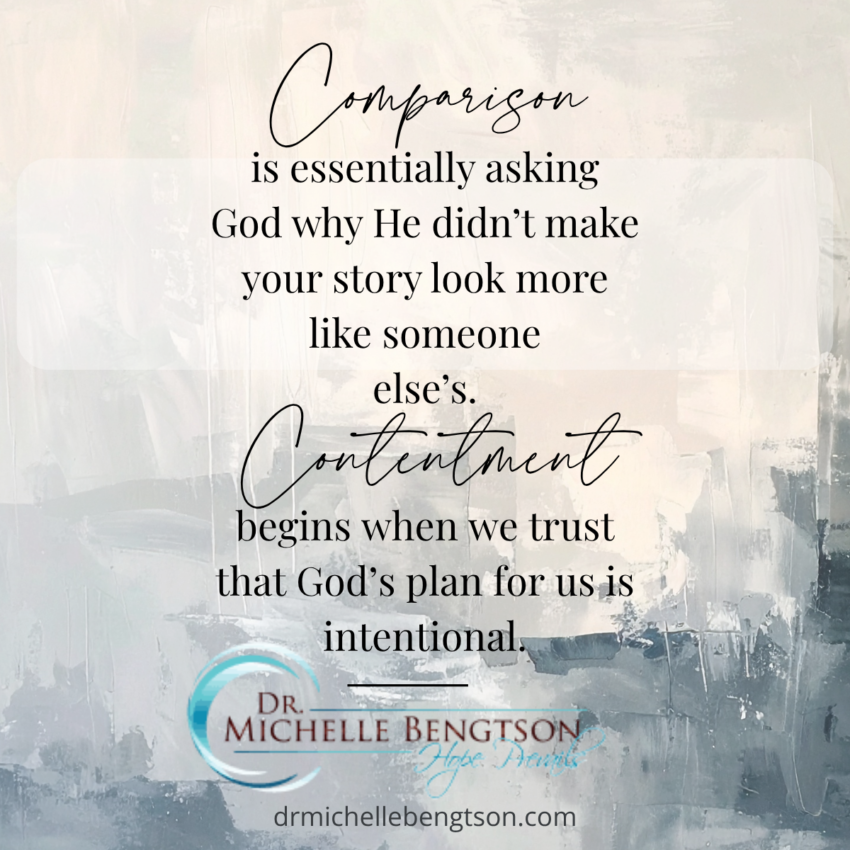
Comparison is essentially asking God why He didn’t make your story look more like someone else’s.
Contentment begins when we trust that God’s plan for us is intentional.
Four Practical Ways to Break Free from Comparison
1. Identify Your Comparison Triggers
Pay attention to when comparison surfaces.
Is it after scrolling social media?
During family gatherings?
At church events?
When talking with certain friends?
Awareness is the first step toward freedom.
You cannot change patterns you don’t recognize.
2. Replace Comparison with Gratitude
Every time you catch yourself comparing, intentionally identify three blessings God has given you.
Gratitude shifts the brain’s focus from scarcity to abundance.
It reminds us that God is actively working in our own lives, even when circumstances look different from someone else’s.
3. Celebrate Others Without Measuring Yourself Against Them
Another woman’s blessing is not evidence of your lack.
God’s resources are not limited.
When we learn to genuinely celebrate others, comparison begins losing its grip.
A friend’s success does not diminish your significance.
4. Focus on Faithfulness, Not Outcomes
God never asks us to compete.
He asks us to be faithful.
Whether your season includes robust health or physical challenges, abundant finances or limited resources, large influence or quiet service, your assignment remains the same: faithfulness.
At the end of our lives, God will not ask whether we measured up to someone else.
He will ask whether we faithfully stewarded what He entrusted to us.
Your Hope Filled Perspective
If you’re still struggling with comparison in your sixties, seventies, or beyond, you’re not alone.
Comparison doesn’t automatically disappear with age because it originates in the heart and mind, not the calendar.
But freedom is possible.
Every time you choose gratitude over envy, truth over lies, and contentment over comparison, you’re renewing both your mind and your spirit.
Remember this: God isn’t comparing you to anyone else. He delights in you as His beloved daughter.
Your story doesn’t need to look like another woman’s story to be beautiful, meaningful, or impactful.
The most freeing realization is this: God never called you to be someone else. He called you to be faithfully and fully the woman He created you to be.
And that is more than enough.
Hope Prevails,
New to The Best-Life Project?
Please read these foundational posts:

Dr. Michelle Bengtson is a hope concierge! She helps people untangle anxiety, trauma, shame, and discouragement through neuroscience and faith-reminding the amygdala it is not the Holy Spirit and perfectionism is not a spiritual gift. Her passion is to share hope and encouragement with others, whether as a board-certified clinical neuropsychologist, host of the award-winning podcast Your Hope Filled Perspective, or the author of several award-winning books including Hope Prevails: Insights from a Doctor’s Personal Journey Through Depression, Breaking Anxiety’s Grip, Today is Going to be a Good Day: 90 Promises from God to Start Your Day Off Right, and The Hem of His Garment: Reaching Out to God When Pain Overwhelms. Her newest release is Sacred Scars: Resting in God’s Promise That Your Past is Not Wasted. You can find her and her many hope-filled resources at DrMichelleB.com.
This is a great article! And I think a lot of these examples need to be taught in childhood so children grow up to be confident in who they are and not comparative adults.
This is something I struggle with on the daily. I don’t struggle with jealousy, it’s more “I’m not enough” than I don’t have enough. Hard to admit as I feel incredibly grateful. I truly appreciate her tips and the reminders of God’s purpose & gifts in my life. ❤️
Susan, I think this is something that the majority of people struggle with to some degree…competition starts early in life. I’m grateful that the Bible even gives examples of competition and teaches us the truth about how God sees us!
Hope Prevails,
Dr. Michelle
Angela, I think you are right. The earlier we learn these things, the less we suffer later in life. Unfortunately, I think extracurricular activities (among other things) encourages competition very young in life. So we as parents and grandparents will need to teach God’s truth in the home.
Hope Prevails,
Dr. Michelle